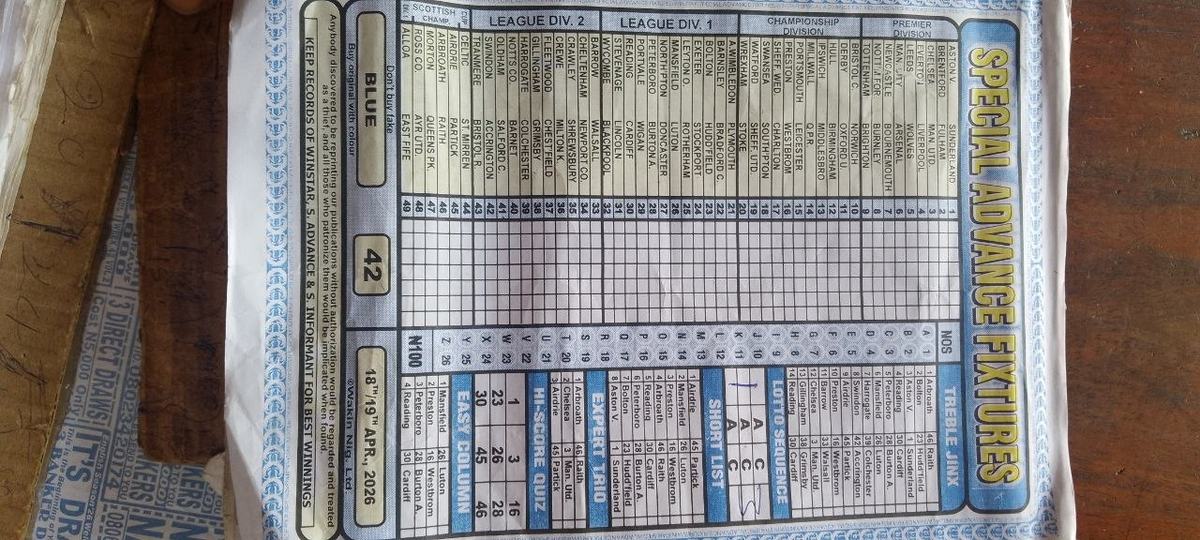
If you've ever filled out a pool coupon or checked the results on a Saturday evening hoping you've hit eight draws, you already know there's nothing else quite like the football pools. They've been around for nearly a century, they've made millionaires out of ordinary punters, and they still pull in players every weekend across the UK, Africa, Australia, and beyond.
But for everything that's been written about the pools, surprisingly few guides explain how they actually work — what you're really betting on, how the coupon is structured, what counts as a winning line, and why some weeks pay out big while others barely pay at all.
This guide walks you through it from start to finish. Whether you're new to the pools or you've been playing for years and want to understand the system better, by the end of this you'll know exactly how it all comes together.
What Are UK Football Pools?
The UK football pools are a form of betting where players try to predict the outcome of football matches on a weekly coupon — but with a specific twist. Unlike traditional sports betting where you pick a winner, pools betting is centered on predicting drawn matches.
The classic pools game is the Treble Chance, where players try to identify which matches on the coupon will end in score draws. Find enough of them, and you share in the prize pool. The more accurate you are, the bigger your share.
Pool betting is a parimutuel system, which means all the stakes from every player are pooled together. After the operator takes its cut, the rest is divided among the winners. There's no fixed payout — your winnings depend on how big the pool is that week and how many other people picked the same draws you did.
This is why pool prizes can swing from modest amounts to life-changing sums depending on the week.
A Brief History: Where the Pools Came From
The football pools were invented in 1923 by Sir John Moores, who founded Littlewoods. The idea was simple but revolutionary — let ordinary people bet small amounts on football for a shot at big winnings, with the prize money pooled together rather than set by a bookmaker.
Through the mid-20th century, the pools became a national institution in the UK. Households across the country would gather on Saturday evenings to listen to the results being read out on the radio. Names like Littlewoods, Vernons, and Zetters became household brands, and weekly pools coupons were a fixture of working-class life for generations.
While the pools have lost some ground to modern fixed-odds betting and online sports betting, they remain a beloved tradition — particularly among players who appreciate the unique blend of football knowledge, pattern study, and pure luck that makes pools betting different from anything else.
The Pool Coupon: What's Actually On It
Every week during the UK football season, pool operators publish a coupon listing the matches available for that round. The coupon typically covers:
- The Premier League — England's top flight
- The Championship — second tier
- League One and League Two — third and fourth tiers
- The Scottish Premiership — Scotland's top division
Some weeks the coupon also includes a small selection of European matches, particularly during international breaks or low-fixture weekends in England.
Each match is given a number — usually from 1 to around 49, depending on the week. Players use these numbers to mark their selections on the coupon. So when you hear someone say "I had numbers 12, 19, 22 and 30 down for draws," they're referring to specific matches by their position on the coupon.
You'll also see notations like EKO (Early Kick-Off) and LKO (Late Kick-Off) on the coupon. These mark games that don't kick off in the standard Saturday 3pm window — Friday night fixtures, Saturday lunchtime games, and Saturday evening matches all get flagged this way.
The Most Important Distinction: Score Draws vs. Scoreless Draws
This is where many new players get tripped up.
Not all draws are equal in pools betting. There are two types, and most traditional pool games only count one of them:
- Score draws — any drawn match where both teams score: 1-1, 2-2, 3-3, 4-4, and so on.
- Scoreless draws — specifically 0-0, where neither team scores.
The classic Treble Chance only pays out on score draws. A 0-0 doesn't count. This sounds harsh, but there's a reason — score draws are slightly less common than non-draws, but more common than 0-0s, which makes them the sweet spot for pools betting. Including 0-0s would change the math too much in players' favor.
That's why our results page at PoolDrawResult lists score draws and scoreless draws separately. When you check your line, you only count the score draws toward your total. The scoreless draws are useful information for studying patterns, but they don't pay the prize.
How to Play: A Step-by-Step Walkthrough
Here's what playing the pools actually looks like in practice.
Step 1 — Get the coupon. Every week, the pool operator releases the new coupon, usually a few days before the matches kick off. The coupon lists all the games for that round, numbered 1 through 49 (or whatever the count is that week).
Step 2 — Pick your draws. Your goal is to select the matches you think will end in score draws. Most pools games require you to pick around 8 numbers, though there are variations. Some players study form, head-to-head records, league tables, and weather forecasts. Others pick by gut feel, by lucky numbers, or by patterns they've noticed over time.
Step 3 — Choose your stake and submit. Pool stakes are typically small — historically as little as a few pence, though the minimums have risen over the years. Once you've chosen your numbers and stake, you submit your line through the operator (online today, though paper coupons still exist in some markets).
Step 4 — Wait for results. Saturday is the main pool day. Matches kick off across the afternoon and evening, and results trickle in as games finish.
Step 5 — Check your line. Once all the matches are completed, you check how many of your selected numbers ended in score draws. If you've hit enough — usually 8 score draws on a winning line — you've won a share of the prize pool.
How Winnings Are Calculated
This is where pool betting really differs from regular sports betting.
In a traditional bookmaker bet, your odds are fixed when you place the bet. If you back a draw at 3.50, you know exactly what you'll get back if it lands.
The pools don't work like that. Instead, every player's stake goes into a single pool. The operator takes its commission (a percentage that varies by operator and game). Whatever's left is divided among the winning lines.
So your payout depends on three things:
- How big the total pool is that week — more players means more money, but also more potential winners
- How many other players hit the same number of draws as you — fewer winners means each share is bigger
- How "rare" your line was — if you hit a combination most players missed, you win more
This is why a low-draw week can produce a massive payout. If only a handful of players guessed enough draws correctly, the pool gets divided into very few shares, and each one becomes substantial. The famous pool jackpots that ran into hundreds of thousands or even millions of pounds back in the day usually came from weeks like this — fewer winners, bigger shares.
Why Some Weeks Pay Out More Than Others
A typical UK pool coupon produces between 10 and 18 draws per week. Within that, roughly 70-80% are score draws, with the rest being scoreless. So on an average week, you're working with maybe 10-14 score draws across the entire coupon.
Weeks vary, though. Low-draw weeks — fewer than 8 score draws across the whole coupon — are nightmare weeks for the operator and goldmine weeks for any winner who manages to hit. Almost no one wins on those weeks, so whoever does scoops a huge share. High-draw weeks — over 20 draws on the coupon — are the opposite. Lots of players hit, the pool gets divided into many shares, and individual payouts are modest.
This is why studying pool history matters. Players who track draw frequency over many weeks build a feel for what's normal, what's unusual, and how to spot weeks that might produce outliers.
Strategies Players Use
Pool betting is part skill, part luck. Here are some of the approaches serious players use.
Form study. Looking at recent results to identify teams that draw often, or fixtures that historically end level. Some sides are notorious for grinding out draws — defensive setups, evenly-matched games, derbies where both teams cancel each other out.
Head-to-head records. Some specific fixtures produce draws year after year. Pool players keep notes on these recurring patterns.
League table position. Mid-table clashes between teams of similar quality often end in draws. Top vs. bottom matches almost never do.
Statistical systems. More dedicated players use spreadsheets to track which numbers have drawn most often over time, looking for cyclical patterns.
Pool predictions. Many players follow tipsters or prediction services that publish weekly picks. Our pool predictions page publishes draw picks every week based on form analysis and pattern study.
None of these methods is guaranteed. Pool betting always involves luck, and even the best system loses regularly. The point of strategy isn't to guarantee a win — it's to make slightly better selections than random chance over the long term.
Pools Betting vs. Fixed-Odds Betting: What's the Difference?
It's worth being clear on how the pools differ from regular sports betting.
Fixed-odds betting (what bookmakers like SportyBet, Bet9ja, and others offer) gives you a set price the moment you place your bet. If your selection wins, you get paid at that price — no matter how many other people bet the same way.
Pool betting doesn't fix the odds. Your payout depends on how many other people hit the same line as you. The more people share the win, the smaller each share is.
This makes the pools more communal in feel. You're not really competing against the bookmaker — you're competing against every other pool player in the country. The operator doesn't care who wins, as long as they take their cut. The size of your prize is determined entirely by the other players around you.
For some, that's the appeal. For others, fixed odds offer more predictability. Both have their place.
What Happens During the Off-Season?
The UK season runs roughly from August to May. Outside that window, the standard coupon doesn't operate.
To bridge the gap, many pool operators switch to Australian football during the UK summer months. The Aussie season runs roughly opposite to the UK calendar, so it provides match content during the UK's quiet months. The format is similar — a weekly coupon with draws as the target — though the leagues and teams are different.
This is why our site covers both UK pool results during the season and Aussie pool fixtures during the off-season. Pool players who want to keep playing year-round have continuous content this way.
Final Thoughts: Why People Still Play
The pools have changed a lot since 1923. They're smaller than they once were, the prizes are typically more modest than the legendary jackpots of old, and online betting has eaten into their player base.
But they're still here. And there's a reason for that.
The pools offer something fixed-odds betting can't — the feeling of being part of a long tradition, the simplicity of one weekly coupon to fill in, and the unique excitement of waiting through a Saturday afternoon to see how many of your numbers came up. There's a slow rhythm to it, a connection to the football calendar, that makes it feel different from clicking around on a betting app.
If you're new to the pools, start small. Pick a few numbers based on whatever method appeals to you, fill in the coupon, and check the results on Saturday evening. Use our results page to verify your line, and study back over previous weeks to start building a feel for how the patterns work.
And remember — pools betting, like all betting, involves financial risk. The fun is in the puzzle, the tradition, and the small thrill of seeing your numbers come up. Treat it as entertainment, play within your means, and enjoy the weekend.
Good luck with your coupon.