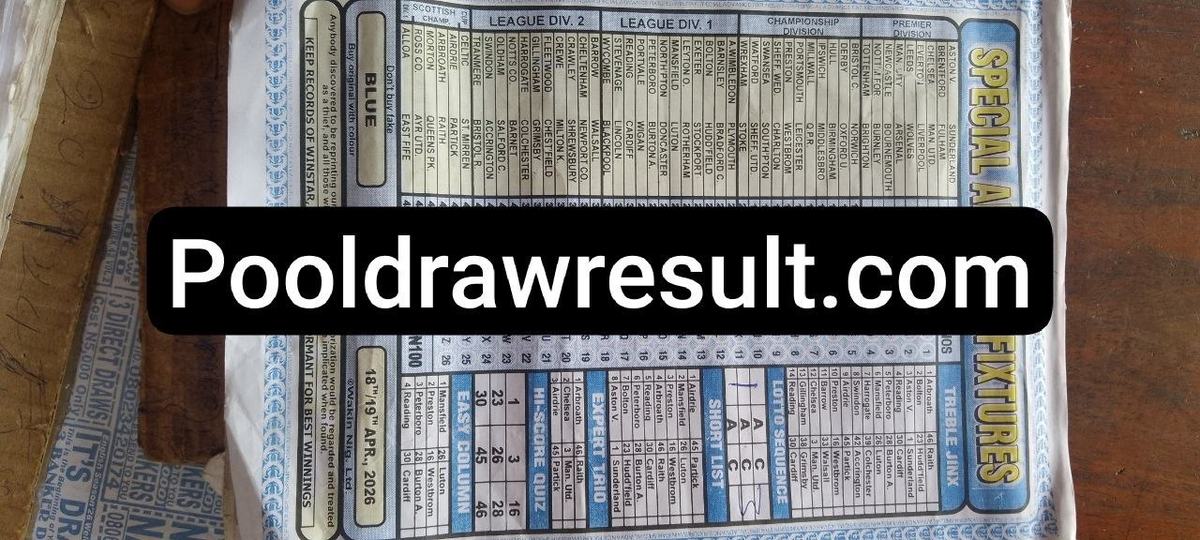
If you've played the UK football pools for more than a few weeks, you've probably noticed something: some weeks are flooded with draws, and others feel like every match ends with a winner. It's one of the first questions new pool players ask me, and even seasoned players still debate it — how many draws actually happen in a typical week?
I've been tracking pool results week after week through PoolDrawResult, and the answer is more interesting than a single number. There's a typical range, but there are also patterns underneath that range — and understanding them can genuinely change how you approach your coupon. Let me walk you through what the numbers actually look like, based on what I've observed across recent seasons.
The Short Answer
On a typical UK pool coupon — usually 49 matches running from the Premier League down through the Championship, League One, League Two, and the Scottish Premiership — you can expect somewhere between 10 and 18 draws per week.
That's a wide range, and there's a reason for it. The middle of the bell curve sits around 13 to 15 draws per week. Anything below 8 is a notably low-draw week. Anything above 20 is unusually high — the kind of week pool players talk about for months afterward.
If you've been playing the pools for a while, this matches what you've felt. Most weekends settle into a rhythm of around a dozen or so draws scattered across the coupon. The outliers are what make the pools exciting — and occasionally devastating.
Why the Number Varies
Several factors push the weekly draw count up or down, and they're worth understanding:
Time of season matters. Early in the season, teams are still finding form. Squads are unsettled, new managers are testing tactics, and matches are more unpredictable — which often means more draws. By February and March, the league tables harden and stronger teams pull away from weaker ones, producing more decisive results and fewer draws.
Fixture density affects fatigue. Christmas and New Year fixture pile-ups, midweek European matches, and international breaks all leave teams tired. Tired teams draw more often, especially in the lower divisions where squad depth is thinner and managers can't rotate the way Premier League sides can.
Weather plays a real role. Wet, windy Saturdays in December and January tend to produce more low-scoring matches and more draws, particularly in League One and League Two where pitches are less protected and conditions level the gap between sides.
The Scottish Premiership pulls draws up. With only 12 teams playing each other repeatedly, the Scottish league produces a higher draw rate than most English divisions. Pool weeks with heavy Scottish coverage tend to bump the total noticeably.
Score Draws vs Scoreless Draws
Not all draws are created equal — and for pool purposes, this matters enormously.
In a typical week with 14 total draws, you can usually expect:
- Around 10 to 11 score draws (1–1, 2–2, 3–3 results)
- Around 3 to 4 scoreless draws (0–0 results)
That ratio holds remarkably steady season after season. Score draws account for roughly 70 to 80 percent of total draws on a normal week. This is good news for pool players, because most traditional UK pools only pay out on score draws — meaning the format naturally favours the more common type of result.
Scoreless draws are rarer because modern football is more attacking than it used to be. In the 1970s and 1980s, 0–0 results were far more common — defences were tighter and pitches were heavier. Today, defensive lapses and high-tempo pressing tend to produce at least one goal in most matches, even between evenly matched sides.
The Unusual Weeks
Every season has its outliers, and they're worth understanding because they tend to be where coupons are won or lost.
Low-draw weeks (under 8 draws) usually happen when title runs are in full swing — when 4 or 5 dominant teams are racking up wins and lower-table teams are losing badly. Late-season weeks, when relegation-threatened teams are desperate and giving everything, also tend to produce fewer draws. Players force results because draws aren't useful to anyone fighting for survival.
High-draw weeks (over 20 draws) are the kind of week that flips coupons upside down. They tend to happen during international fatigue periods, after midweek European games for top sides, or in cold-weather windows when conditions level the playing field. I've personally tracked weeks with 22 and even 24 draws — they're rare, but they happen perhaps two or three times a season.
Knowing this helps with expectation management. If you've had three high-draw weeks in a row and you're feeling lucky, the odds suggest a regression to the average is coming. The pools rarely give and give without taking back.
What This Means for Your Coupon
Understanding the typical draw count isn't just trivia — it shapes how you should think about your selections.
If you select 18 draws on your coupon and only 12 actually land, that's not bad luck — that's a normal week. Sizing your selections to match the realistic range matters. Selecting too few makes hitting bankers harder; selecting too many spreads your stake too thin and waters down your returns.
The smartest pool players I've watched over the years don't try to predict every single draw. They focus on identifying the 4 to 6 most likely draws and building their coupon around those. The rest is a numbers game, played with discipline rather than greed.
For week-by-week analysis, our pool predictions page breaks down the upcoming coupon, and our archive lets you study past weeks to spot patterns yourself.
Final Thoughts
So how many draws happen in a typical pool week? Between 10 and 18, with the average sitting around 13 to 15. But averages don't win coupons — patterns do. Watch the season's rhythm. Pay attention to fixture congestion. Note which weeks produce more scoreless draws than usual.
The pools reward patient observation far more than they reward hunches. Track the numbers long enough and you start to see the shape of the season hidden inside them.
Play responsibly, and only stake what you can afford to lose.
Emem runs PoolDrawResult from Lagos, Nigeria, and has spent years tracking weekly pool fixtures and results. Follow the latest week's results on the homepage, updated every Saturday.